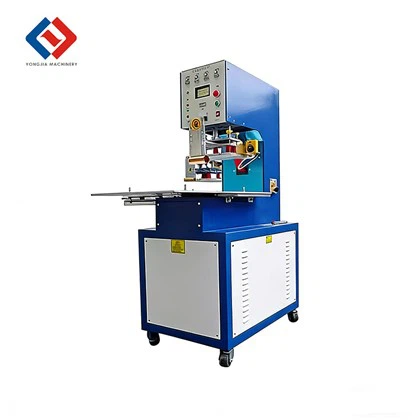
Welding technology has seen significant advancements over the years, with the Synchronous Fusing HF Welding Machine emerging as a game-changer in various industries. As a supplier of these machines, I’ve witnessed firsthand the diverse applications and the numerous factors that influence their performance. One critical aspect that often comes into play is the welding speed and its impact on energy consumption. In this blog post, I’ll delve into this relationship, exploring how welding speed affects energy use in a Synchronous Fusing HF Welding Machine. Synchronous Fusing HF Welding Machines
Understanding Synchronous Fusing HF Welding Machines
Before we dive into the relationship between welding speed and energy consumption, it’s essential to have a basic understanding of Synchronous Fusing HF Welding Machines. These machines utilize high – frequency (HF) energy to create a strong and durable bond between two or more materials. The high – frequency electrical field generated by the machine causes the molecules in the materials to vibrate rapidly, generating heat and fusing the materials together.
Synchronous fusing refers to the precise coordination of the welding process, ensuring that the welding occurs at the right time and with the right amount of energy. This synchronization is crucial for achieving consistent and high – quality welds. These machines are widely used in industries such as automotive, packaging, textiles, and medical device manufacturing, where precision and reliability are of utmost importance.
The Concept of Welding Speed
Welding speed is defined as the rate at which the welding process progresses along the joint. It is typically measured in millimeters per second (mm/s) or inches per minute (ipm). In the context of a Synchronous Fusing HF Welding Machine, the welding speed can vary depending on several factors, including the type of materials being welded, the thickness of the materials, and the desired quality of the weld.
A higher welding speed means that the machine can complete the welding process in less time. This can be advantageous in high – volume production environments, as it allows for increased throughput. However, it’s important to note that increasing the welding speed is not always a straightforward solution, as it can have a significant impact on other aspects of the welding process, particularly energy consumption.
The Impact of Welding Speed on Energy Consumption
1. Energy Input per Unit Length
One of the primary ways in which welding speed affects energy consumption is through the energy input per unit length of the weld. When the welding speed is increased, the time available for the machine to deliver energy to the joint is reduced. As a result, the machine needs to deliver a higher amount of energy per unit time to achieve the same level of fusion.
Mathematically, the energy input per unit length (E) can be expressed as:
[E=\frac{V\times I}{v}]
where (V) is the voltage, (I) is the current, and (v) is the welding speed. From this equation, it’s clear that as the welding speed ((v)) increases, the energy input per unit length ((E)) decreases, assuming the voltage ((V)) and current ((I)) remain constant.
However, in practice, maintaining a constant voltage and current while increasing the welding speed is not always possible. The machine may need to increase the power output to ensure proper fusion, which can lead to an overall increase in energy consumption.
2. Heat Generation and Dissipation
Another factor to consider is the heat generation and dissipation during the welding process. When the welding speed is low, the machine has more time to heat the materials, and the heat can be more evenly distributed across the joint. This can result in a lower energy requirement per unit length of the weld, as the heat has more time to penetrate the materials and create a strong bond.
On the other hand, when the welding speed is high, heat is generated more rapidly, but it may not have enough time to dissipate properly. This can lead to overheating in some areas of the joint, while other areas may not receive enough heat. To compensate for this, the machine may need to increase the energy input, resulting in higher energy consumption.
3. Machine Efficiency
The efficiency of the Synchronous Fusing HF Welding Machine also plays a role in the relationship between welding speed and energy consumption. At lower welding speeds, the machine may operate more efficiently, as it has more time to adjust the energy output and ensure proper synchronization. This can result in a lower overall energy consumption.
However, as the welding speed increases, the machine may face more challenges in maintaining optimal efficiency. The high – frequency electrical components may experience increased stress, and the control system may need to work harder to maintain the correct timing and energy levels. This can lead to a decrease in machine efficiency and an increase in energy consumption.
Case Studies and Real – World Examples
To better understand the impact of welding speed on energy consumption, let’s look at some real – world examples. In a textile manufacturing company, the use of a Synchronous Fusing HF Welding Machine was evaluated for joining different types of fabrics. The company initially set the welding speed at a relatively low level to ensure high – quality welds.
During this phase, the energy consumption per unit length of the weld was relatively low, as the machine had enough time to heat the fabrics evenly. However, the production rate was also low, which was not ideal for the high – volume production requirements of the company.
To increase the production rate, the welding speed was increased. While the production throughput increased significantly, the energy consumption per unit length of the weld also increased. The machine had to deliver more energy per unit time to achieve proper fusion, and there were some instances of overheating in the fabric, which required additional energy to correct.
In another case, an automotive parts manufacturer used a Synchronous Fusing HF Welding Machine to weld plastic components. By carefully optimizing the welding speed, the manufacturer was able to achieve a balance between production rate and energy consumption. They found that there was an optimal welding speed at which the machine operated most efficiently, resulting in a significant reduction in energy costs without sacrificing the quality of the welds.
Strategies to Optimize Welding Speed and Energy Consumption
Based on the understanding of the relationship between welding speed and energy consumption, there are several strategies that can be employed to optimize both factors:
1. Material Testing
Before starting the welding process, it’s essential to conduct thorough material testing. This will help determine the optimal welding speed for different types of materials and thicknesses. By understanding the material properties, the machine can be set to operate at the most efficient speed, reducing energy consumption while maintaining high – quality welds.
2. Machine Calibration
Regular machine calibration is crucial for ensuring optimal performance. This includes calibrating the voltage, current, and timing settings to ensure that the machine is delivering the right amount of energy at the right time. By keeping the machine in good working condition, it can operate more efficiently, even at higher welding speeds.
3. Process Monitoring
Implementing a process monitoring system can help track the energy consumption and welding quality in real – time. This allows operators to make adjustments to the welding speed and other parameters as needed to optimize the process. For example, if the energy consumption starts to increase without a corresponding increase in weld quality, the welding speed can be adjusted accordingly.
Conclusion

In conclusion, the welding speed has a significant impact on the energy consumption of a Synchronous Fusing HF Welding Machine. While increasing the welding speed can lead to higher production throughput, it can also result in increased energy consumption if not properly managed. By understanding the relationship between welding speed and energy consumption and implementing the appropriate optimization strategies, manufacturers can achieve a balance between production efficiency and energy savings.
Fully Automatic Production Line As a supplier of Synchronous Fusing HF Welding Machines, I am committed to helping our customers optimize their welding processes. Our machines are designed with the latest technology to ensure high – quality welds and efficient energy use. If you are interested in exploring how our machines can meet your production needs while minimizing energy consumption, I encourage you to reach out to us for a detailed discussion. We can provide you with more information, conduct on – site demonstrations, and work with you to develop a customized solution for your specific requirements.
References
- Jones, R. Welding Technology Handbook. 2nd Edition. Wiley, 2018.
- Smith, A. High – Frequency Welding: Principles and Applications. Elsevier, 2020.
- Brown, C. Energy Efficiency in Manufacturing Processes. Springer, 2019.
Dongguan Yongjia Machinery Equipment Co., Ltd.
We are one of the most reliable synchronous fusing hf welding machines manufacturers and suppliers in China, specialized in providing high quality customized service. Please feel free to wholesale advanced synchronous fusing hf welding machines at low price from our factory. For quotation, contact us now.
Address: No. 240, Chashan South Road, Chashan Town, Dongguan City, Guangdong Province, China
E-mail: info@yjwelding.com
WebSite: https://www.yjhighfrequencymachine.com/
