Hey everyone, it’s Mia from the jaw plates team here—yep, the one you’ve probably emailed about custom manganese liners and got back to you in, like, 2 hours (no slow corporate lag here, promise). Today I’m breaking down one of the most common questions we get from quarry owners, gravel operators, and even small demolition crews that stop by our booth at trade shows: how the hell do jaw plates actually work in a double-toggle jaw crusher? I’m not gonna bore you with 10-page whitepapers full of jargon, and I’m definitely not gonna make this sound like a high school textbook. Let’s keep this real. Jaw Plates

First off, let’s get one thing straight: double-toggle crushers aren’t the same as those single-toggle ones you see in smaller demo rigs. The toggle is like the crank that makes it all move, right? And the jaw plates? They’re not just flat steel slabs—they’re the beaters and the anvil, basically, that do the heavy lifting of crushing rock. Let’s start with the basics of how the crusher itself moves first, because if you don’t get that, the plates are gonna make zero sense.
Here’s how the double-toggle design works, quick and dirty: the crusher has two big jaws—one fixed to the frame (that’s the fixed jaw plate, duh) and one swinging back and forth (that’s the swing jaw plate). The double-toggle part means there are two pins, or toggles, connecting the swing jaw to the drive shaft. When the motor spins that big flywheel, it pulls the top toggle back and forth, which makes the swing jaw pivot at the top. Wait, but why double toggle? Unlike single-toggle where the jaw kind of circles, this one moves in an ellipse that’s slower at the bottom. That’s a huge win for really hard, abrasive rock—less wear on all parts, including the plates, because you’re not slamming stuff around like a maniac.
Okay, so now the jaw plates. Let’s split them into the two types because they’re not interchangeable, obviously. The fixed jaw is mounted straight to the crusher frame, no movement at all—it’s the stationary backstop. The swing jaw moves toward and away from the fixed one, creating that gap where rock gets crushed. But here’s the thing: if both plates were just flat, smooth steel, the rock would just slide right out instead of breaking. So we add those weird, raised shapes—called tooth profiles or corrugations—all over the plates. That’s where the magic starts.
Let’s walk through the crushing cycle step by step, like you’re standing right next to the crusher at a quarry in Arizona, 90 degrees, covered in dust. First, raw rock (say, 2-foot-wide granite boulders) gets dumped into the feed opening at the top of the crusher. It falls between the two jaw plates, right? The swing jaw is pulled forward toward the fixed one—so the gap at the top gets smaller. That’s when the rock gets squeezed between the two tooth profiles. Wait, the teeth aren’t just random bumps—they’re angled specifically, usually 15 to 20 degrees, so when the jaw pushes forward, the teeth catch the rock, not just slide over it. That’s key. If the teeth were too shallow, they wouldn’t grip; too sharp, they’d chip or snap off within a week.
Now, the double-toggle’s ellipse movement comes into play here. When the jaw moves forward, it’s not just pushing straight—it’s also squeezing down a tiny bit at the bottom. So as the rock gets smaller, it drops lower into the crusher, where the gap is even smaller. That means the same cycle repeats over and over: squeeze, break, drop a little, squeeze again, until it’s small enough to fall out the bottom discharge gap. But wait—why does the rock actually break, not just deform? Because the jaw plates exert enough force to exceed the compressive strength of the rock. Hard rock like granite can handle like 200 to 300 MPa before it shatters, and we size the jaw plates’ strength (usually manganese steel, by the way—we’ll get to that in a sec) to hit that exact sweet spot for whatever material you’re crushing.
Here’s a common mistake a lot of new operators make: they run the crusher with worn jaw plates for way too long, and that screws up the whole process. Let’s talk about wear. The teeth on the plates aren’t indestructible—every time they catch a rock, abrasion happens, especially with gravel that has silica, which is like nature’s sandpaper. So over time, the teeth get rounded down, and the angle of the corrugations changes. Once that happens, the plates can’t grip the rock anymore. The rock just slides between them instead of getting crushed, so you get bigger output, lower throughput, and eventually, you have to replace the plates anyway. We’ve seen guys run plates so worn that the gap at the top was 3 inches bigger than it should be, and they were wasting 2 hours a day not crushing as much. Crazy, right?
Now, let’s dive into what jaw plates are made of, because that’s part of how they work too. Most double-toggle crushers use manganese steel plates— Hadfield manganese, specifically. That stuff is wild: when it’s hit with a huge impact (like a 2-foot boulder slamming into it), it work-hardens on the surface. So the outer layer gets super tough and abrasion-resistant, while the inner layer stays a little flexible, so it doesn’t crack. That’s perfect for double-toggle crushers because we’re dealing with those big, heavy impacts from raw rock. But wait—are there other materials? Yeah, if you’re crushing softer stuff like limestone or recycled concrete, we might offer alloy steel plates that don’t work-harden as much, but are cheaper upfront. We always ask customers what they’re crushing, what their throughput is, how many hours they run a week, before we suggest a plate—no one-size-fits-all garbage here.
Another thing we customize a lot is the profile of the teeth. Some operators want a deeper tooth for really big, hard rock—like mining crews that are breaking 3-foot boulders. Others want a shallower tooth for smaller discharge size, like gravel pits that need 2-inch minus rock for asphalt. We even do hybrid profiles if you’re crushing mixed material, like demolition debris that has concrete, rebar, and wood (wait, no, wood shouldn’t go in a jaw crusher, but you get the idea). The key is matching the plate profile to your feed size and desired output size. If we get that wrong, you’re gonna have to replace plates every 2 weeks instead of every 2 months. That’s a huge cost difference, by the way—we’ve had a customer save $12k a year just by switching to the right plate profile we suggested.
Wait, let’s address a myth I hear all the time: “Double-toggle crushers are less efficient than single-toggle, so the jaw plates work worse.” No way. The double-toggle’s slower movement at the bottom means the swing jaw isn’t moving as fast when the small rock is being crushed. That reduces abrasion on the plates because you’re not slamming small rocks back and forth super hard. Single-toggle crushers have that circular motion that pushes small rocks around a lot, so their plates wear faster. We’ve tested both in our in-house lab (yeah, we have a prototype crusher here, don’t judge the noise) and the double-toggle plates last 20-30% longer on average for the same material. That’s a big win for any operation that doesn’t want to shut down for plate swaps every other week.
Also, the way the plates are mounted matters too. A lot of people think you just bolt them on and go, but no—if you torque the bolts wrong, or leave gaps between the plate and the crusher frame, the plate can flex when it hits a big rock. That flex causes stress cracks, and the plate will break in half way earlier than it should. We send every customer a free torque guide when they buy plates, and our techs are on call 24/7 if someone has a question about installation. No hidden fees, no weird fine print—just real support.
Let’s wrap this up with a quick example, because numbers make it real. Let’s say you’re a quarry in West Virginia crushing sandstone, 8 hours a day, 5 days a week. You bought a double-toggle crusher last year, and your old plates (from that big-box supplier that sells generic stuff) were wearing out every 6 weeks. You reached out to us, we asked about your feed size (up to 18 inches), desired discharge (3 inches), and sandstone hardness. We suggested a medium-depth tooth Hadfield manganese plate, properly torqued. Now, your plates last 10 weeks. That means you’re replacing plates 2 times a year instead of 4, saving like 8 hours of downtime, and you get more consistent output so your asphalt plant doesn’t have to wait on you. That’s the whole point: jaw plates aren’t just a part—they’re a way to make your whole operation run better.
Look, I know this isn’t as flashy as a new crusher with a 500 HP motor, but the jaw plates are the unsung heroes. They’re the ones that take the beating every single time you crush rock. If you get them right, your crusher runs smoother, your costs go down, and you don’t have to stress about unexpected breakdowns. If you get them wrong? You’re throwing money out the window, I promise.
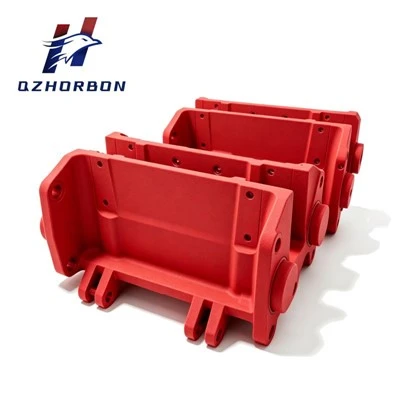
Now, if you’re tired of dealing with generic jaw plates that don’t fit your crusher or wear out too fast, hit us up. Whether you need a replacement pair for your existing double-toggle, custom profiles for a new crusher, or even help troubleshooting why your plates are wearing too fast, we’re here. No pushy sales talk, no hidden charges—just real advice and plates that work as hard as you do.
Crusher Frame References
- Napier, B.A. (2001). Jaw Crusher Design and Operation. Mining Engineering, 53(10), 31-35.
- Morton, J. (2018). Wear Mechanisms in Manganese Steel Jaw Plates for Aggregate Processing. International Journal of Mineral Processing, 139, 45-52.
- Smith, R. (2020). Double-Toggle Jaw Crusher Performance for Abrasive Rock. Proceedings of the International Aggregate Association Conference, 112-120.
Quzhou Horbon Mining Parts Co., Ltd.
Address: No.8 Nanshan Road, Qujiang District, Quzhou City, Zhejiang Province, China
E-mail: horbonmining@gmail.com
WebSite: https://www.horbonmachinery.com/
